Using AI Tools to Evaluate Your Auto Repair Shop Website: A Smarter Approach
AI is everywhere right now, and for good reason.
More and more shop owners are using tools like ChatGPT to evaluate their website, analyze their brand, compare themselves to competitors, and even identify their “ideal customer.”
We love that.
Seriously.
If you’re curious enough to audit your own marketing, you’re already ahead of most shops.
But here’s the important part:
AI is a tool. Strategy requires context.
If you’re going to use ChatGPT (or any AI tool) to evaluate your shop, here’s how to do it the right way and how to interpret what it gives you.
What AI Does Well
Where AI Has Blind Spots
Here’s what most shop owners don’t realize:
AI does
not automatically have access to your real performance data.
Unless you specifically provide it, AI cannot see:
- Your actual Google rankings
- Live search volume in your ZIP code
- Your Google Business Profile insights
- Your conversion rates
- Your revenue mix by service
- Your close rate
- Your technician capacity
- Your CRM data
- Your local competitor’s real traffic data
- Backend SEO settings (schema, canonicals, indexing rules)
So when it says:
- “Your highest ranking competitor is X”
- “Your target demographic is likely upper-middle-income families”
- “You should target these psychographics”
- “You are positioned as premium”
It may be directionally interesting but it’s often based on assumptions, pattern recognition, or generalized market modeling.
That doesn’t make it wrong.
It just means it’s incomplete.
The Difference Between Interpretation and Data
AI interprets what it sees. Real strategy requires data.
For example:
AI can look at your website and say:
“You appear to appeal to affluent, outdoor-oriented families.”
But it doesn’t know:
- If 60% of your revenue is fleet work
- If your average repair order is $480 or $1,280
- If your top customers drive 10-year-old vehicles
- If you’re actually capacity-constrained
- If your market is price-sensitive
AI can’t see your bay utilization.
It can’t see your car count trends.
It can’t see your retention metrics.
And those things matter more than website adjectives.
How to Write a Better AI Prompt
If you're going to use AI to analyze your shop, the quality of what you get back depends entirely on what you put in.
A prompt like:
"Analyze my website and tell me my brand and ideal customer."
…will get you a generic answer. The AI will look at your site (if it can — more on that below) and make assumptions based on patterns.
A better approach is to give it context it can't find on its own:
- Your ZIP code and the surrounding cities you serve
- Your top 5 revenue-generating services
- Your average repair order value
- Whether you position as premium, value, fleet-focused, or specialty
- Your top 3–5 competitors (ones you've verified, not ones the AI guesses)
- Who your actual best customers are — not who you wish they were
You can also paste in your website URL and your Google Business Profile link. But here's the important caveat:
just because you paste a link doesn't mean the AI actually read it. Some versions of ChatGPT can browse the web. Some can't. And even the ones that can don't always process every page the way you'd expect. If the AI gives you detailed feedback about your site, it's worth asking yourself:
did it actually look at my site, or does this sound like it could apply to any auto repair shop?
The more specific and honest your inputs are, the more useful the output will be. AI performs based on what you give it. That hasn't changed since the first computer.
A Word of Caution: Don't Use AI to Validate AI
This one's important.
If you run an analysis in ChatGPT and then ask ChatGPT whether its own analysis is correct, it will almost always say yes. That's not because it verified anything — it's because these tools are designed to be helpful and agreeable. They're not going to argue with themselves.
The same applies if you take ChatGPT's output and paste it into Google Gemini, Perplexity, or Claude to "get a second opinion." You'll likely get a response that sounds confirming — but all you've really done is ask a different AI to evaluate the first AI's assumptions. None of them are checking real data. They're all working from the same general knowledge and pattern recognition.
Think of it this way: if you asked one friend to guess your shop's ideal customer, and then asked a different friend to evaluate that guess, neither of them has looked at your books.
Real validation comes from real data:
- Your actual Google Analytics
- Your Google Business Profile insights
- Your search rankings from tools like Ahrefs or Semrush
- Your CRM and point-of-sale data
- Your revenue by service line
If an AI recommendation can't be confirmed by at least one of those sources, treat it as an idea to explore — not a fact to act on.
How to Validate AI Recommendations
When you receive an AI audit, ask yourself:
- Is this based on actual ranking data, or assumptions?
- Does this align with my real customer base?
- Does this match my revenue model?
- Is this something already handled at the platform level?
- Would this conflict with my technical SEO setup?
- Is this advice specific to my market or generic?
If the recommendation is:
“Add more content.”
That’s not wrong.
It’s just not strategic on its own.
Strategic SEO asks:
- What content?
- Targeting which search volume?
- Against which competitors?
- For which service margin?
- With what conversion goal?
That’s a different level of analysis.
The Layer AI Can’t Replace
AI is excellent at ideation.
But it cannot replace:
- Aligning marketing with technician capacity
- Balancing lead volume with bay availability
- Integrating CRM data into strategy
- Tying SEO to actual revenue
- Adjusting positioning based on car count trends
- Building long-term retention strategy
- Managing real-world conversion optimization
Marketing for auto repair shops isn’t just about traffic.
It’s about:
- The right customers
- At the right margin
- At the right volume
- With sustainable retention
- That’s where strategy lives.
The Smart Way to Use AI
Here’s our recommendation:
Use AI to:
- Spark ideas
- Challenge your assumptions
- Identify messaging opportunities
- Think differently about your positioning
But validate those ideas with:
- Real search data
- Local competitive analysis
- Your actual performance metrics
- Technical SEO review
- Conversion tracking
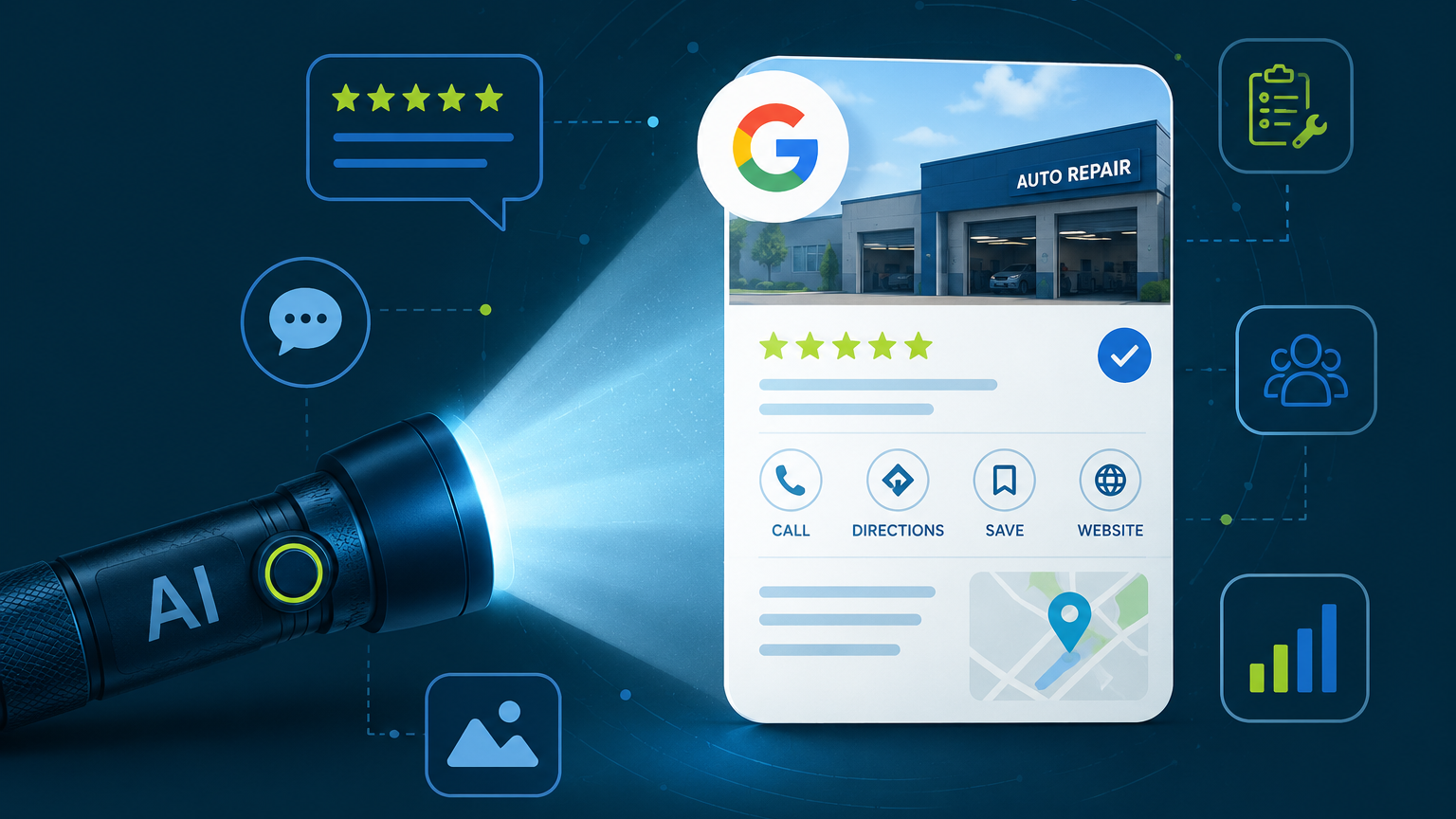
AI is a flashlight.
Data is the map.
You need both but you need to know which one you’re holding.
Final Thought
We’re big believers in technology. We build it.
And AI is absolutely going to play a growing role in how shops evaluate their marketing.
Just remember:
An AI audit is a starting point.
Not a final strategy.
If you’ve run an AI analysis on your shop and want help interpreting the results through real market data and performance insights, we’re always happy to take a look.
Because ideas are powerful.
But execution backed by real data is what fills bays.
AI is a Flashlight, Not a Map Series
Catch up on the series:
Post 2 •
Post 3 •
Post 4 •
Post 5 •
Post 6 •
Post 7 •
Post 8
For the full framework:
The Shop Owner’s Guide to AI in Marketing.
Heather Myers is the Chief Technology Officer at KUKUI, where she builds marketing and customer engagement technology for independent auto repair shops. Before joining the automotive technology space, she built information systems for public and academic libraries.
This is the first post in our ongoing series, AI Is a Flashlight, Not a Map. New posts publish every two weeks.