This is the question we hear the most right now:
“Can I use AI to write my website content? My blog posts? My emails? Will Google penalize me for it?”
It’s a fair question. With tools like ChatGPT, it’s easier than ever to create a service page, a blog post, or an email in minutes. And there’s no shortage of people online telling you that Google will punish you for it.
The short answer: no.
Google does not penalize AI-generated content.
The real answer is more nuanced. And the nuance is where shops either save a lot of time or quietly hurt their visibility.
What Google Actually Says
Google has been clear on this, and their position hasn’t changed: they evaluate content based on quality, not on how it was created.
Their exact framing: they reward “helpful, reliable, people-first content, however it is produced.”
That means:
- AI-written content can rank well.
- Human-written content can be penalized if it’s thin, generic, or unhelpful.
- The creation method isn’t the issue. The quality is.
Google’s own team has used the phrase “human-curated” rather than “human-created.” That distinction matters. They’re not asking whether a person typed every word. They’re asking whether a person reviewed it, verified it, and made sure it actually serves the reader.
What Google Does Penalize
If Google doesn’t penalize AI content, what do they penalize?
Scaled content abuse.
That’s their term. It means mass-producing content primarily to manipulate search rankings. Google added this as a specific spam category in their guidelines, and it applies equally to AI-generated and human-written content.
Common examples in auto repair:
- Dozens of city pages with identical content and different ZIP codes swapped in.
- Generic service pages that say nothing a customer would actually find useful.
- Blog posts that don’t go beyond basic definitions anyone could find in a Google search.
The penalty targets the behavior, not the tool.
A Simple Test for Your Content
Before publishing anything, AI-generated or not, ask yourself:
- Does this actually help a customer make a decision?
- Is this specific to my shop, my services, and my area?
- Would someone feel more confident calling after reading this?
- If I removed this page, would anyone notice?
If the answer to any of those is no, the content has a problem. How it was written isn’t the issue.
Where AI Content Works
AI is genuinely useful for content creation. The key is understanding what it’s good at and keeping a human in the loop.
AI is strong at:
- First drafts.
Getting past the blank page is the hardest part of writing. AI can give you a structured starting point in seconds.
- Generating ideas.
“Give me 10 blog post ideas for an auto repair shop heading into summer” produces a list you can pick from and refine.
- Organizing information.
If you have rough notes or bullet points about a service, AI can turn them into a clear service page, a blog outline, or an FAQ.
- Editing and clarity.
Paste in a draft and ask AI to check for grammar, simplify technical language, or adjust the tone from stiff to conversational.
Every one of these is a starting point. Not a finished product.
Where AI Content Falls Short
AI doesn’t know your shop. It doesn’t know your market. It doesn’t know your customers. And this is where most shops get into trouble.
- It can’t write from experience.
A page about brake repair that says “brake repair is important for safety” is something any AI can produce. A page that explains what your technicians actually look for during a brake inspection, what questions customers typically ask, and what to expect when they bring their car in? That takes a human who knows your shop.
- It can’t verify its own claims.
AI will confidently list services you don’t offer, mention certifications you don’t have, or describe your process incorrectly. Every factual claim needs to be checked before publishing.
- It can’t sound like you.
AI writing tends to be polished, slightly formal, and generic. Your shop has a personality. If every page on your site reads like it was written by the same chatbot, customers feel that.
- It can’t add local relevance.
What your community cares about, what the driving conditions are like in your area, and which vehicles you see the most. This is what makes your content genuinely useful and genuinely yours. AI can’t provide it.
The Right Process: AI Draft to Finished Content
Here’s the workflow that gets you the speed of AI without the risks:
1. Use AI to generate a draft.
Get the structure, the outline, and a starting point on the page. Don’t worry about it being perfect. That’s not the point.
2. Add your real expertise.
Your process. Your experience. Your customer insights. The things that make your shop different from the template.
3. Verify everything.
Check services, claims, certifications, anything factual. AI doesn’t know what’s true about your business. You do.
4. Make it sound like your shop.
Adjust the tone. Make it conversational, local, and specific. If it could belong to any shop in any city, it’s not done.
5. Ask the real question.
Does this help a customer? Does this answer the questions someone would have before picking up the phone? If yes, publish. If not, keep working.
How We Use It at KUKUI
We build websites and create content for auto repair shops every day. AI is part of our process. Here’s how:
- Ideation.
Generating topic ideas, exploring angles, brainstorming headlines.
- Rough drafts.
Getting a structured first pass that our team can then rewrite, fact-check, and make specific to the shop and market.
- Editing.
Catching errors, tightening language, checking readability.
What we don’t do: generate a page and publish it.
Every piece of content goes through human review. Someone verifies the facts. Someone makes sure it sounds like the shop, not like a template. Someone checks that it actually helps a customer.
We’ve seen what happens when that step gets skipped. Inaccurate service descriptions. Generic pages that could belong to any shop in any city. Content that technically exists but doesn’t perform.
Google’s quality raters have a specific flag for this: AI content that “lacks human oversight and review” gets rated as the lowest quality. Content that’s been edited, fact-checked, and improved by a human doesn’t get that flag, regardless of how the first draft was created.
The Real Question
The question isn’t: “Can I use AI to write content?”
The question is: “Will this content actually help my customers?”
If AI helps you create something that’s accurate, specific to your shop, written in your voice, and genuinely useful to someone looking for your services, use it. Google doesn’t care how you got there. Your customers don’t care how you got there. They care whether the page answers their questions.
If AI gives you a generic draft that you publish without reading, without verifying, and without making it yours, you have a problem. Not because Google will catch you. Because your customers will. A page that could belong to any shop doesn’t give anyone a reason to choose yours.
What’s Next
Next in the series, we’re going deeper on the fact/inference/guess framework we introduced in
Post 2
. More examples, more practice, and a method you can use every time you get a report, an audit, or a recommendation from an AI tool.
If you’re new to the series:
Catch up on the series:
Post 1
•
Post 2
•
Post 3
•
Post 4
•
Post 5
•
Post 6
•
Post 7
•
Post 8
For the full framework:
The Shop Owner’s Guide to AI in Marketing
.
Heather Myers is the Chief Technology Officer at KUKUI, where she builds marketing and customer engagement technology for independent auto repair shops. Before joining the automotive technology space, she built information systems for public and academic libraries.
This is the fourth post in our ongoing series,
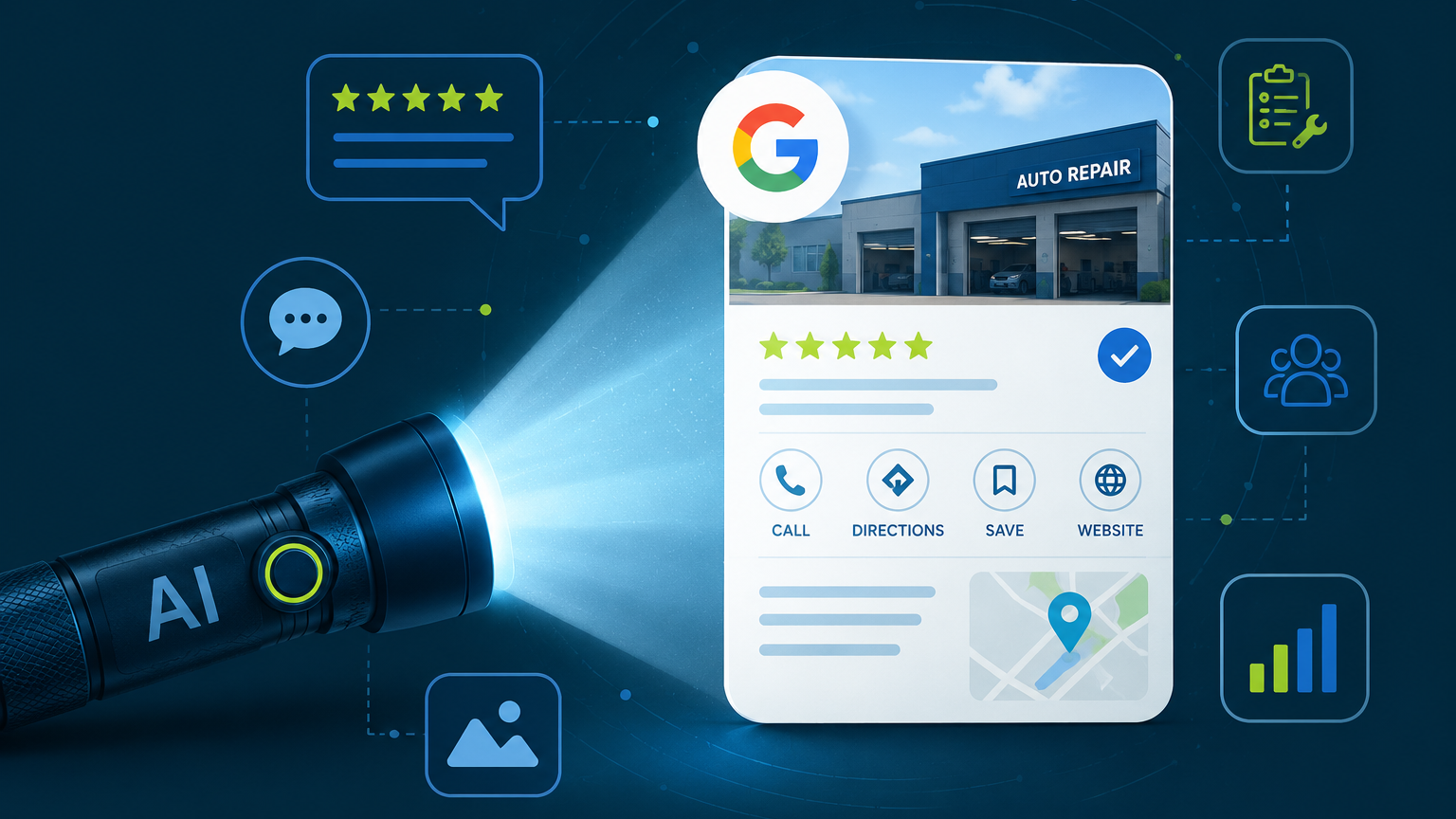
AI Is a Flashlight, Not a Map
. New posts publish every two weeks.