For six posts, this series has been about how shop owners use AI. How to prompt it. How to evaluate its output. How to tell the difference between a fact and a guess.
This post flips the lens.
Your customers are using AI too. And the way they find and choose a repair shop is changing because of it.
This isn’t a future prediction. It’s happening now.
What’s Changed
For years, finding an auto repair shop meant one thing: Google. You searched “auto repair near me,” you looked at the map pack, you checked the reviews, you picked one, you called.
That’s still the most common path. But it’s no longer the only one.
Google AI Overviews now appear at the top of many search results. Before the map pack. Before the blue links. Before the ads. A generated answer that summarizes what Google’s AI thinks is the best response to the query. Sometimes it recommends businesses by name.
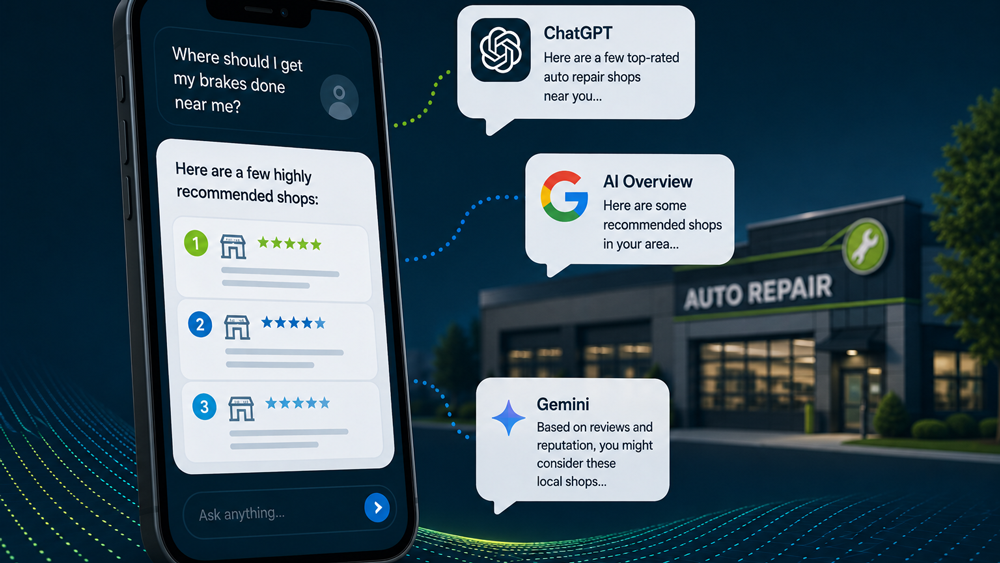
Meanwhile, more people are searching directly in AI tools. ChatGPT. Gemini. Claude. Instead of typing a query into Google, they’re asking an AI: “Where should I get my brakes done near me?” or “What’s the best auto repair shop in my area?”
The results don’t look anything like a Google search page. There’s no map pack. No ten blue links. No ads. Just a recommendation. Maybe two or three. That’s it.
If your shop isn’t showing up in those recommendations, you’re missing a growing segment of potential customers who never saw you at all.
Is Organic Search Dead?
No. Let’s get that out of the way.
Google is still where the vast majority of customers find local businesses. Traditional search, the map pack, the blue links, the ads. That’s still the primary path to your phone ringing. AI-powered search tools still represent a small fraction of total search volume for local services.
But “small fraction” today doesn’t mean small fraction next year. The trajectory matters. More people are using AI tools to search every month. Google is integrating AI into its own results. And the shops that start paying attention now will have a significant advantage over the ones that wait until it’s obvious.
Think of it this way: the shops that took Google Business Profile seriously in 2015 had a two-year head start over the ones who waited until 2017. The same window is opening with AI search right now.
So no, organic search isn’t dead. But it’s no longer the only conversation. And the good news (we’ll get to this below) is that the same work that helps you in organic search also helps you in AI search.
The Consistency Problem
Here’s something about AI search that’s fundamentally different from Google: the same question doesn’t always get the same answer.
Try it yourself. Open two fresh conversations in ChatGPT. Ask the exact same question in both. You’ll often get different shops recommended, in a different order, with different reasoning.
Now change the phrasing slightly. “Where should I get my brakes done” vs. “I need a trusted mechanic” vs. “cheapest brake repair near me.” Different results again.
This isn’t a bug. It’s how these models work.
And there’s another layer. In
Post 2
, we talked about how some AI tools have web search enabled, and some don’t. The same is true here. Whether an AI tool is searching the live web or answering from its training data changes the results entirely. A recommendation from ChatGPT with web search turned on and ChatGPT without it can be completely different shops. The customer has no idea which mode they’re in.
In traditional search, ranking is relatively stable. You can track your position. You can see where you stand vs. competitors. AI search doesn’t work that way. There’s no fixed position to rank for. The results are fluid, contextual, and different every time. That’s a fundamental shift from what we’re used to.
What We’re Seeing
We’ve been actively testing AI search visibility across platforms. Here’s what we can share so far:
Results vary significantly across platforms.
Ask the same question on Google AI Overviews, ChatGPT, Gemini, and Claude, and you’ll get different businesses recommended. A shop that shows up consistently on one platform may be underrepresented on another. There’s no single leaderboard.
Results vary within the same platform.
Same query, two different conversations, different recommendations. Phrasing, conversational context, and whether web search is active all influence what comes back. This is not the stable, trackable environment that traditional search was.
The businesses that show up consistently tend to share the same traits.
Strong reviews (quantity and quality). A complete, active Google Business Profile. Content-rich websites with genuine expertise. Consistent business information across the web. FAQ-style content that directly answers the questions customers ask.
Nobody has cracked the code.
Not in this industry. Not in any industry. This is early days, and it’s reminiscent of the early Google era when ranking factors weren’t published, and the only way to understand what worked was through testing. That’s where we are right now with AI search. The platforms don’t publish how they decide which businesses to recommend. The only way to learn is to test, observe, and adapt. And what works today may not work the same way in six months, because these platforms are evolving faster than anything we’ve seen in search.
What Actually Helps
Here’s the good news: the fundamentals that drive organic and local search visibility are the same fundamentals that feed AI search. You don’t need to start over. You need to do what already works, and do it well.
- Reviews.
Probably the single strongest signal across every AI platform we’ve tested. Not just the number. The recency, the detail, and the sentiment. AI models are reading your reviews, not just counting them.
- Google Business Profile.
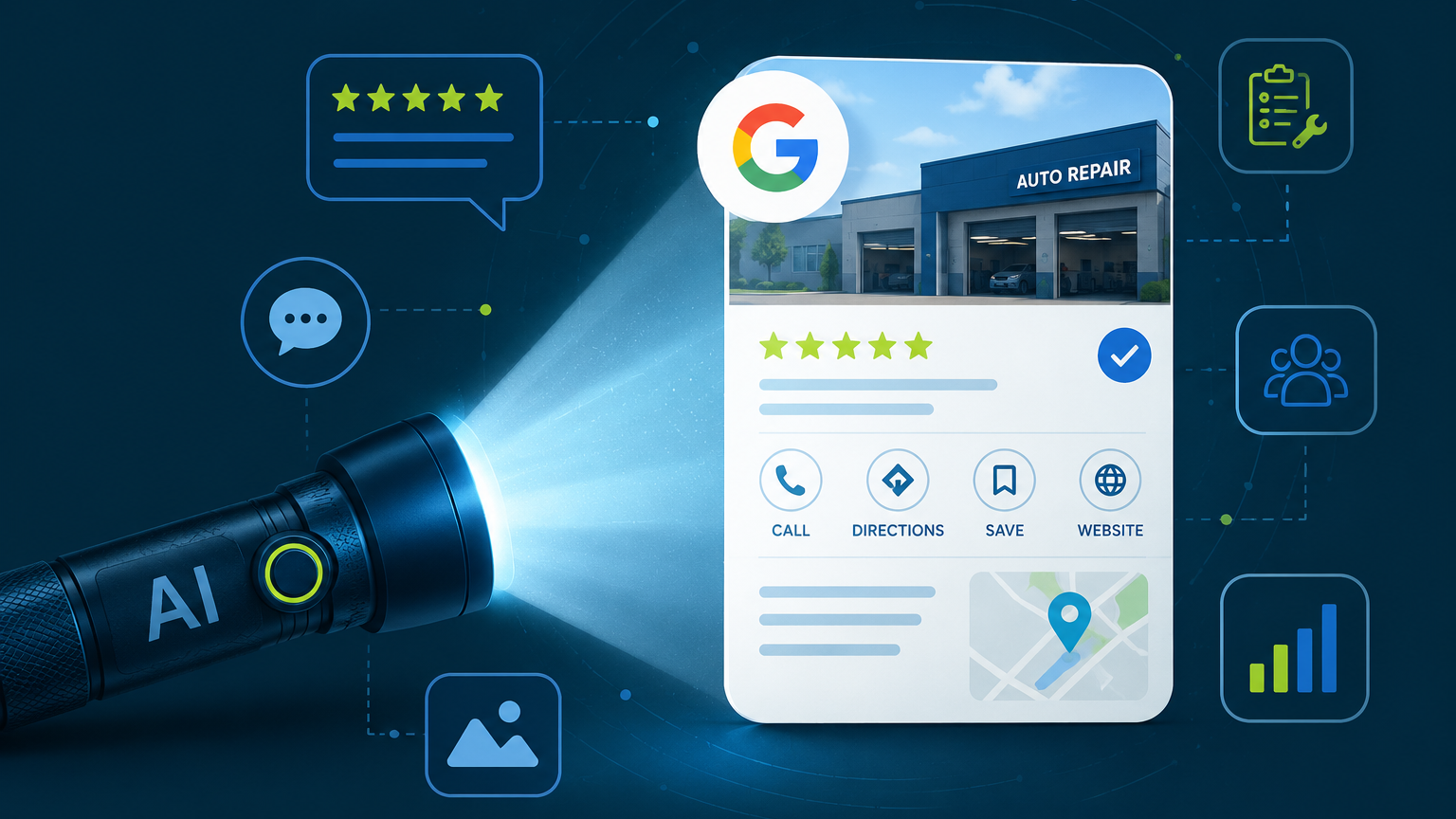
Complete, accurate, and active. Categories, services, hours, photos, posts. Gemini pulls directly from Google’s own data, so your GBP is especially important for Google’s AI features.
- Content that demonstrates real expertise.
Service pages that explain what you actually do, not generic descriptions. FAQ content that answers the questions your customers really ask. Blog posts that show you understand your craft and your market.
- Consistent business information.
NAP (name, address, phone) consistency across every directory, listing, and mention of your business on the web. AI models cross-reference multiple sources. Conflicting information makes you less likely to be recommended.
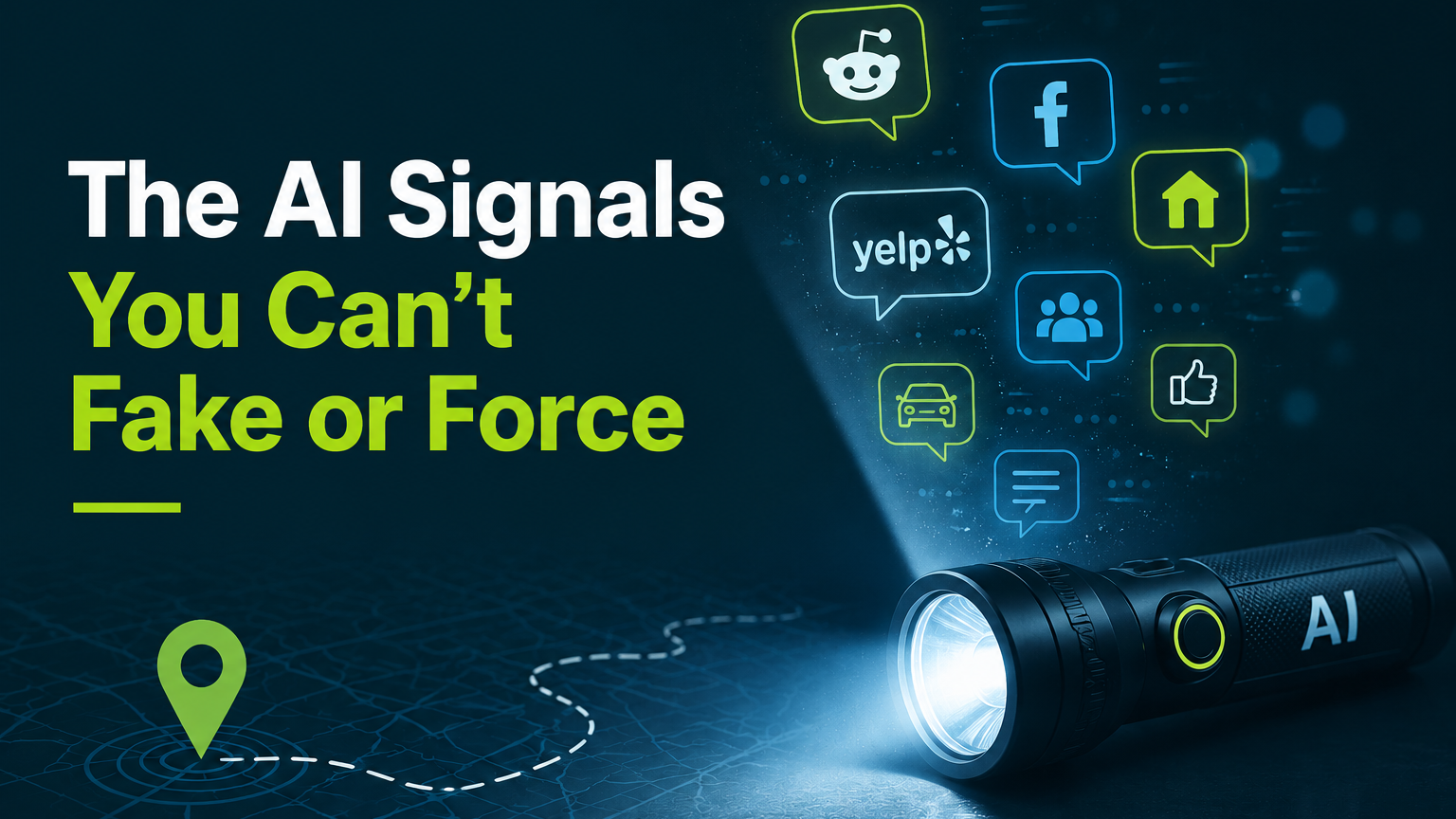
And it goes beyond your website and Google. AI models pull from a wide range of sources when forming recommendations:
•
Third-party review sites.
Yelp, CarFax, RepairPal. Your Google reviews matter most, but AI models see reviews across platforms. A shop with strong reviews in multiple places sends a stronger signal than one that only exists on Google.
•
Industry directories.
ASE, ASA, and other professional associations. These are trust signals. Being listed in recognized industry directories tells an AI model that your business is established and credible.
•
Online forums.
Reddit in particular. AI models reference forum discussions when people ask for local recommendations. If your shop gets mentioned in local Reddit threads, that’s real-world word of mouth that AI can see.
•
Social media presence.
Active, consistent social media signals that your business is real, engaged, and current. (Shameless plug: KUKUI’s Social Toolkit [LINK] helps shops manage this without it becoming a second job.)
Most of these are things you or your team need to build and maintain directly. They’re not things a website provider can do for you. But they’re part of the picture AI models see when deciding who to recommend.
On the technical side, we’re also working on ways to help AI platforms better understand our clients’ websites. Last year, we deployed llms.txt files across KUKUI sites, which provide a structured summary that helps AI models read and interpret site content. (
We wrote about that
here
.
) We’re continuing to test and develop new approaches as the landscape evolves.
What Doesn’t Work
There’s a temptation to hear “AI search is the future” and respond by generating hundreds of pages of content. More pages, more chances to show up, right?
Wrong. Mass-producing thin, repetitive content doesn’t help you in AI search. It doesn’t help you in traditional search either. Google already penalizes this as scaled content abuse (we covered that in Post 4). AI models are likely to treat it even more harshly, because they’re curating a single recommendation, not serving a page of ten results. They’re looking for signals that you’re a credible, relevant answer to the question. Volume doesn’t create those signals. It dilutes them.
Quality beats volume. Every time. In every search environment.
A Word of Caution
If you’ve been in this industry for any length of time, you’ve heard the pitch: “We’ll get your shop to the first page of Google. Guaranteed.”
That was the magic elixir of the last decade. A lot of shop owners paid for it. Some got results. Many didn’t. And the ones who got burned learned an expensive lesson about promises that can’t be kept.
AI search is going to produce the same kind of promises. “We’ll get your shop recommended by ChatGPT.” “We’ll guarantee AI visibility.” “Our proprietary system cracks the AI code.”
Be skeptical. The platforms don’t publish their recommendation criteria. The results change from conversation to conversation. Nobody has a reliable, repeatable formula. Anyone who guarantees AI search placement is selling the 2026 version of guaranteed first-page Google rankings. Same pitch. Same problem.
The shops that will come out ahead aren’t the ones who find a hack. They’re the ones who build a strong online presence that works everywhere: traditional search, AI search, and whatever comes next.
Where We Are
To be transparent, this is early. The platforms are changing constantly. What works today may not work the same way in six months.
That means doing the fundamentals right. It means working with providers who are actively studying this and adapting. And it means not chasing shortcuts that trade long-term credibility for short-term visibility.
We’ll keep sharing what we learn as we learn it.
What’s Next
Next in the series, we’ll look at how AI is specifically changing your Google Business Profile: AI-generated review summaries, business descriptions, and what Google’s AI features mean for how customers experience your listing before they ever visit your website.
Catch up on the series:
Post 1
•
Post 2
•
Post 3
•
Post 4
•
Post 5
•
Post 6
•
Post 7
•
Post 8
For the full framework:
The Shop Owner’s Guide to AI in Marketing
.
Heather Myers is the Chief Technology Officer at KUKUI, where she builds marketing and customer engagement technology for independent auto repair shops. Before joining the automotive technology space, she built information systems for public and academic libraries.
This is the seventh post in our ongoing series,
AI Is a Flashlight, Not a Map
. New posts publish every two weeks.