AI Search Is Getting Personal
Why Your CRM Just Became an AI Visibility Tool
You’ve had this experience.
You’re talking to someone about needing new running shoes. You didn’t search for shoes. You didn’t click on anything. You just mentioned it in conversation. And then, within hours, every ad on your phone is Nike.
Or you’re chatting with your spouse about a vacation spot. Next time you open Instagram, there it is. Sponsored. Exactly the destination you were just talking about.
Whether these platforms are actually listening through your microphone (they say they’re not) or whether they’re just incredibly good at predicting your behavior from cross-device tracking, browsing patterns, and purchase history, the result is the same: the technology knows things about you that you didn’t explicitly tell it.
Now imagine that same capability built into search. Intentional, transparent, and with your explicit permission.
That’s what’s happening right now. And it changes what “visibility” means for your business.
A Note Before We Go Further
We’ve kept the product mentions light throughout this series. A shameless plug here, a shameless plug there. This post is different.
KUKUI is a marketing and CRM platform. The shift we’re about to describe directly involves email marketing, appointment communications, follow-up campaigns, review requests, text messaging, and social media. Those are our products. That’s what we build.
So instead of pretending this is purely educational and dropping in references, we’re going to be straightforward: we’re using our own tools as examples throughout this post because they’re the ones we know inside and out. If you use different tools for the same functions, the principles still apply. But we’re not going to pretend we’re not a CRM company writing a post about why CRM matters more than ever.
Search Just Got a Memory
For most of its existence, search has been stateless. You type a query. Google returns results based on what’s publicly available. It doesn’t know whether you’ve been to that auto repair shop before. It doesn’t know you have an appointment confirmation from them in your email. It doesn’t know you got a follow-up text last week reminding you about your brake inspection.
That’s changing.
In January 2026, Google launched Personal Intelligence for AI Mode. When a subscribed user opts in, Google’s AI can access their Gmail inbox and Google Photos when generating search recommendations. It can read appointment confirmations, purchase receipts, service reminders, travel bookings, and follow-up emails.
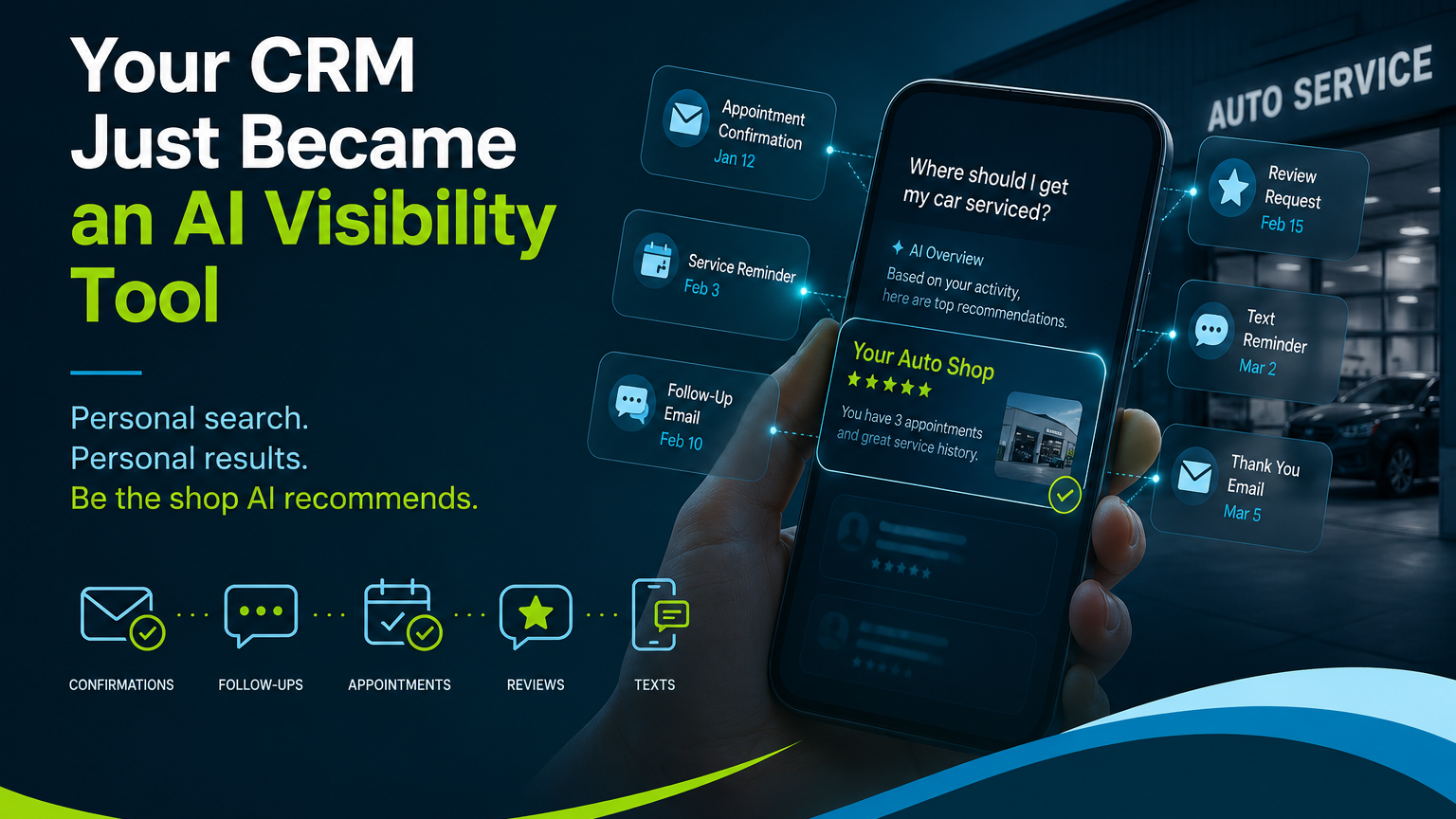
In practical terms: a customer with Personal Intelligence enabled asks “Where should I get my car serviced?” and the AI can see that they have three appointment confirmations from your shop in their inbox, a follow-up email about declined brake work, and a thank-you message from their last visit. That’s context no public SEO signal can provide.
Currently, the feature is limited to U.S. personal accounts and requires explicit activation. The adoption numbers aren’t huge yet. But the direction is unmistakable.
The Major Platforms Are All Moving This Direction
Google is the most explicit about connecting personal data to search, but they’re not alone.
Microsoft Copilot uses email, calendar, files, and Microsoft 365 context to help users summarize, draft, and act on information. When a user asks Copilot to help them find a service provider, it can reference past Outlook conversations. The application is more productivity-focused than search-focused right now, but the data pipeline is the same: private business communications becoming assistant context.
Meta announced that interactions with Meta AI will be used to personalize content and ads across Facebook and Instagram. This is significant because Meta already uses a dense blend of behavior, identity, and engagement signals for ad targeting. AI conversations are now another input. For local businesses running Facebook ads, this means the line between organic engagement and paid targeting just got thinner.
ChatGPT now supports connectors for Gmail, Google Calendar, contacts, and other apps. When users link these services, ChatGPT becomes context-aware: it can reference past emails, upcoming appointments, and contact history. It’s not a local search engine, but when a connected user asks “who was that mechanic my friend recommended?” and the answer is in their email, ChatGPT can find it.
Apple Intelligence is integrating AI across Mail, Messages, and Siri. Apple’s ecosystem advantage is the same as Google’s: they already have the inbox, the messages, the calendar. The AI layer connects them.
The pattern is the same everywhere: AI is gaining access to private user data (with permission) and using it to make recommendations more personal. Every platform with a large installed base of email, messaging, or productivity users is doing some version of this.
What This Means for Your Shop
Here’s where it gets practical. Every digital communication your shop sends to a customer is a data point that AI can potentially access when that customer searches.
Think about what’s sitting in your customers’ inboxes and message threads right now:
- Appointment confirmations.
- Service reminders.
- Follow-up emails after a visit.
- Declined service notifications.
- Review requests.
- Seasonal promotions.
- Thank-you messages.
- Text reminders and confirmations.
Every one of those is a piece of evidence that your shop has an existing relationship with that customer. When AI can see that evidence, it changes what “visibility” means. You’re not just trying to be discoverable to strangers. You’re trying to be memorable to the people who already know you, in a way that AI can see and reference.
This is not traditional SEO. This is not AEO. This is CRM as an AI signal.
How KUKUI’s Platform Maps to This Shift
Here’s where we drop the pretense. Every communication channel we build is now a potential AI touchpoint.
Email campaigns. Service reminders, seasonal promotions, educational content, follow-ups. Every email that lands in a customer’s Gmail is a data point Personal Intelligence can reference. The shops sending consistent, relevant email communication are building inbox presence without knowing it.
Appointment confirmations and reminders. These are exactly the type of structured, transactional emails that AI systems are designed to parse. Google specifically calls out “booking confirmations” as a data type Personal Intelligence uses. Every confirmation your shop sends is telling Google’s AI “this person has a relationship with this business.”
Follow-up campaigns. Declined service follow-ups. Thank-you emails after visits. Check-in calls and messages. These create ongoing touchpoints that keep your shop in the customer’s inbox and message history. AI doesn’t just see the last email. It can see the pattern of communication over time.
Review requests. Every review request email or text is a touchpoint. And when the customer responds by leaving a review, that’s another data point on another platform that AI can cross-reference.
Text messaging. SMS appointment reminders, follow-ups, and marketing messages. The evidence that SMS is directly feeding AI search systems is still limited. But text messages create durable customer engagement history, and as Apple Intelligence and Google’s AI expand into messaging, this channel becomes more relevant.
Social media. KUKUI’s Social Toolkit handles consistent posting across Facebook, Instagram, and Google Business Profile. With Meta now using AI interactions to personalize content and ads, your social engagement isn’t just building community. It’s training Meta’s AI on who your audience is and what they respond to.
None of this was built because we predicted AI would read inboxes. It was built because consistent customer communication drives retention, reviews, and revenue. The AI visibility layer is a bonus that’s getting more valuable every month.
One More Layer: Structured Data in Email
Google supports JSON-LD structured data inside emails. This is markup that helps AI systems parse appointment details, order confirmations, and event information directly from the email without reading the prose.
For auto repair shops, this means appointment confirmations and service reminders that include structured data (date, time, service type, business name, address) are more machine-readable than plain-text emails. AI systems can extract the key details instantly.
This is something we’re actively evaluating for our email templates. The opportunity is to make every communication our platform sends as AI-readable as possible, so that when Google’s AI scans a customer’s inbox, it can extract structured information about the shop relationship cleanly and accurately.
The Reality Check
We need to be straightforward about where this stands today.
- Google Personal Intelligence requires opt-in and explicit activation. Not every customer has it.
- ChatGPT connectors require users to explicitly link their accounts. Most haven’t.
- Apple Intelligence is rolling out gradually. Adoption varies.
- There are no public numbers on what percentage of users have connected their inbox to an AI assistant.
We’re not able to definitively state that email marketing is a confirmed AI ranking factor. Yet.
What we are saying is this: the trajectory is clear. Every major platform is building toward a world where AI uses private context to personalize recommendations. The shops that have been doing consistent CRM and communication work are on the right side of that trajectory. They’re building the data trail that AI will increasingly be able to see.
And even if you set aside the AI angle entirely, everything we just described (email campaigns, appointment reminders, follow-ups, review requests, text messaging, social engagement) already drives retention and revenue on its own. The AI layer doesn’t change whether you should be doing this work. It just adds another reason why it matters.
A Note on Privacy
We recognize this topic touches on questions about privacy and data access. This post is about marketing strategy, not privacy policy, so we’re not going to attempt a comprehensive privacy analysis.
What we will say: every feature discussed in this post is opt-in. Users choose to connect their inbox, link their apps, or enable AI access to their personal data. None of it happens automatically or without consent. If you’re a consumer who wants to know how to manage these settings, each platform has its own privacy controls:
- Google: Settings > AI Mode > Personal Intelligence
- ChatGPT: Settings > Connected Apps
- Apple: Settings > Apple Intelligence & Siri
- Meta: Settings > Meta AI
The broader conversation about how much personal data AI should access is important and ongoing. For the purposes of this post, we’re focused on one question: given that these features exist and adoption is growing, what does that mean for how local businesses think about customer communication?
Where This Is Heading
Search is moving from “what’s the best answer to this query” to “what’s the best answer for this person.”
That’s a fundamental shift. It means visibility isn’t just about being findable by strangers anymore. It’s about being present in the digital life of the people who already know you, in channels that AI can see.
Your website matters. Your GBP matters. Your reviews matter. Your Reddit mentions and social presence matter. We’ve covered all of that in this series.
Now add your inbox presence. Your text message history. Your appointment confirmations. Your follow-up emails. The entire communication trail between your business and your customers. AI is learning to read that trail. And the shops that have been building it consistently are going to have an advantage that’s very hard to replicate.
The technology that used to creepily know you were shopping for running shoes? It’s becoming the technology that knows you already trust your mechanic. And when it does, it’s not going to recommend a stranger.
What’s Next
We’ve been testing AI visibility across hundreds of locations for the last several months. What actually moves the needle? What doesn’t? What surprised us? We’ll be sharing the results in an upcoming post.
If you’re new to the series:
Catch up on the series: Post 1 • Post 2 • Post 3 • Post 4 • Post 5 • Post 6 • Post 7 • Post 8 • Post 9
For the full framework: The Shop Owner’s Guide to AI in Marketing.
Heather Myers is the Chief Technology Officer at KUKUI, where she builds marketing and customer engagement technology for independent auto repair shops. Before joining the automotive technology space, she built information systems for public and academic libraries.
This is the tenth post in our ongoing series, AI Is a Flashlight, Not a Map. New posts publish every two weeks.
Categories
Archives