The AI Signals You Can't Fake or Force
Why the Sources You Don't Control Matter the Most
Throughout this series, we’ve talked about the things you can control to improve your AI visibility. Your Google Business Profile. Your website content. Your review responses. Your service descriptions. All of that still matters. It’s the foundation, and without it, nothing else works.
This post is about the additional layer that most shop owners aren’t prioritizing yet.
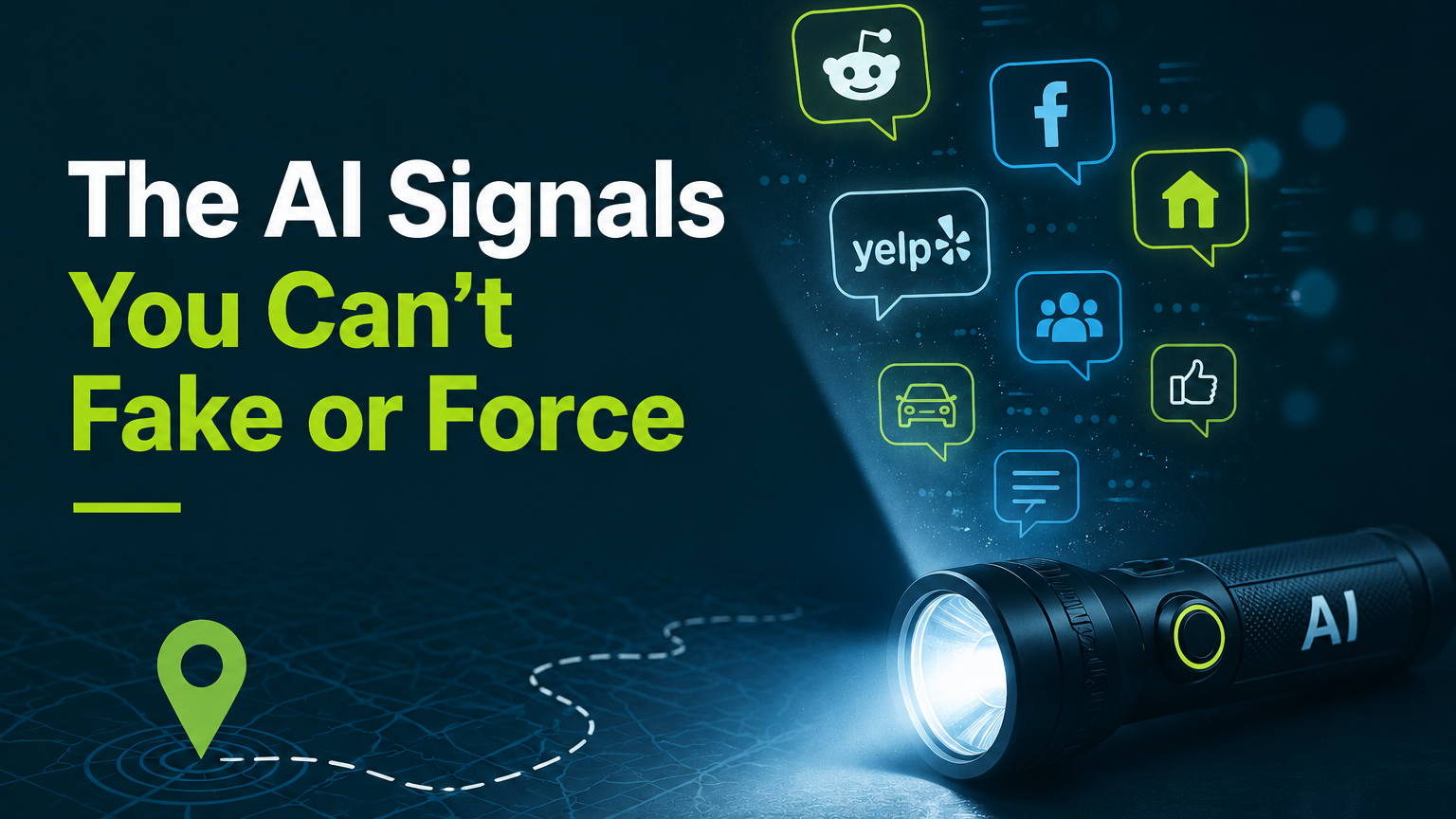
Reddit threads. Facebook group recommendations. Nextdoor suggestions. Car forum discussions. Yelp reviews. These are places where real people talk about real experiences with real businesses. You can’t optimize them. You can’t pay for them. You can’t automate them.
There is no single smoking gun for AI visibility. It’s not your website alone. It’s not your GBP alone. It’s not these uncontrolled channels alone. It’s everything working together. But this layer is the one most businesses are ignoring, and it’s worth understanding why AI pays attention to it.
Why These Signals Carry Weight
AI models weigh different sources differently when deciding who to recommend. Your website and GBP are important because they’re detailed and structured. Your Google reviews are important because there are a lot of them, and they’re easy to verify.
But uncontrolled sources carry their own kind of weight, precisely because they’re hard to game.
You can write your own website content. You can craft your GBP description. You can manage your Google review profile. AI models know that businesses control those channels. That doesn’t make them less valuable. It just means AI also looks for corroborating signals from places you don’t control.
A customer recommending your shop in a local Reddit thread? That’s unsolicited. Unpaid. Unscripted. It’s one more data point that confirms what your website and GBP are already saying. When the controlled and uncontrolled signals align, that’s a strong recommendation.
The data backs up how much attention AI pays to these sources. The 5W AI Platform Citation Source Index, which analyzed over 680 million citations across ChatGPT, Gemini, Claude, and other major AI models, found Reddit at the top of the citation hierarchy across most platforms. Not because Reddit is more trustworthy than your website. Because it’s a different kind of evidence that complements everything else.
The Sources AI Is Reading
Beyond your website and Google, here’s where AI models are pulling information about your business:
Reddit. Local subreddits like r/[YourCity] are where people ask "who do you trust with your car?" and get real answers. AI models see these threads as peer recommendations. Most subreddits have strict rules around self-promotion, and posting about your own business will get you downvoted or banned in many of them. Some have specific windows for it (like weekly self-promotion threads), and shop owners can always participate as community members by being genuinely helpful. But the mentions that carry the most weight with AI are the organic ones: a real customer recommending your shop without being asked.
Yelp. Here’s something most people don’t know: Yelp is licensing its review data directly to OpenAI. Your Yelp reviews aren’t just on Yelp. They’re being fed into the AI models that power ChatGPT search. A strong Yelp presence with detailed reviews is no longer optional. It’s a direct input to the system.
Facebook groups and Nextdoor. Community recommendation threads (“Does anyone know a good mechanic?”) are exactly the kind of content AI models use to identify trusted local businesses. These conversations happen every day in every market.
Car enthusiast forums. Niche communities where people discuss specific vehicles and repairs. If your shop specializes in a particular make or type of work, forum mentions from satisfied customers carry significant weight.
Third-party review sites. CarFax, RepairPal, BBB. AI models cross-reference reviews across platforms. A shop with strong reviews on multiple sites sends a stronger trust signal than one that only exists on Google.
Industry directories. ASE, ASA, AAA Approved Auto Repair. These are professional trust signals. Being listed in recognized industry directories tells an AI model that your business is established and credible.
The Baseline: What Tools Handle for You
Before we talk about what only you can do, let’s cover the foundation. There are tools that handle the consistent, repeatable work that keeps your digital presence active and accurate across platforms.
Consistent posting. Social media needs to be active. Not once a month when you remember. Consistent. KUKUI’s Social Toolkit (shameless plug) handles two professional posts per week across Facebook, Instagram, and Google Business Profile. That keeps your profiles current and signals to AI that your business is active.
Directory listings and NAP consistency. Your business information needs to match everywhere. Name, address, phone number, hours, services. Every discrepancy is a trust signal in the wrong direction. We offer Yext as an add-on that syncs your information across directories automatically. (Also available bundled with Social Toolkit.)
Review responses. We’ve covered this in depth over the last few weeks. Responding to every review, on every platform, consistently. KUKUI’s AI Review Responder handles this, trained specifically for how auto repair shops talk to their customers.
This is the floor. It keeps the lights on across your digital presence. And it matters. AI models do look at posting frequency, listing accuracy, and review engagement.
But it’s not what separates you from every other shop in your market.
The Layer Only You Can Add
Two posts a week keeps your profiles active. What makes them real is the content that could only come from your shop.
- The photo of your tech holding the weirdest thing they pulled out of an engine this week.
- The post thanking a customer by name for ten years of loyalty.
- The before-and-after of a repair that shows your team’s work.
- The community event you sponsored. The Little League team. The car show.
- The answer you gave in a local Facebook group when someone asked a car question. No pitch. Just helpful.
None of this can be automated. That’s the point. AI models are learning to distinguish between a business that has a social media presence and a business that has an actual community presence. The automated posts tell AI you’re active. The real content tells AI you’re trusted.
This also applies to how you engage. Responding to comments on your posts. Answering questions on Nextdoor. Being genuinely helpful in Facebook groups without ever mentioning your shop name. The shops that do this naturally are the ones that get mentioned when someone else asks for a recommendation. And those mentions are the signals AI values most.
What You Can’t Control but Can Influence
You can’t write your own Reddit thread. You can’t script what someone says about you in a Facebook group. You can’t make a customer post about you on Nextdoor.
But you can be the shop they think of when the question gets asked.
Every Reddit recommendation, every Facebook group mention, every forum thread where someone says “go see [your shop], they took care of me” started the same way: a customer had an experience worth talking about.
That means the single most effective thing you can do for AI visibility in these uncontrollable channels is exactly what you’d do anyway if AI didn’t exist:
- Provide exceptional service.
- Communicate clearly.
- Follow up after visits.
- Handle problems honestly.
- Be visible in your community.
AI didn’t create the value of reputation. It just made reputation visible in a new way. The shops that have been doing this for years are discovering they have an AI advantage they didn’t know they were building.
Monitor What’s Out There
You can’t control these channels, but you should know what’s being said. A few simple steps:
- Search your shop name on Reddit. Go to reddit.com and search your business name. You might find nothing. You might find a recommendation thread you didn’t know about. Either way, you should know.
- Set up Google Alerts. Free. Takes two minutes. You’ll get an email whenever your shop name appears on a new web page.
- Ask AI about your shop. We covered this in Post 2. Open ChatGPT, Gemini, or Claude and ask: “What can you tell me about [your shop name]?” Then ask: “Who would you recommend for auto repair in [your city]?” The answers tell you where you stand.
- Check your reviews beyond Google. Yelp, CarFax, RepairPal. Are your profiles claimed? Are reviews being responded to? These platforms are feeding AI directly.
The Bottom Line
AI visibility isn’t one thing. It’s everything.
Your website. Your GBP. Your reviews. Your content. Your directory listings. Your social presence. And the conversations happening about your business in places you don’t control. No single channel wins on its own. They work together. When a customer finds you recommended on Reddit, then sees a strong GBP profile, then reads detailed reviews, then lands on a website with real expertise? That’s how AI recommendations become phone calls.
And those calls are different. A customer arriving from an AI recommendation has already been informed. They've already been told your shop is the one to trust. They're not browsing a list and comparing five options. They're closer to a decision before they ever reach your site. That's a fundamentally different kind of traffic than traditional search delivers.
Tools can automate the foundation. Consistent posting. Directory accuracy. Review responses. That’s important work, and it’s worth doing well.
But the signals that complete the picture are the ones that can’t be automated. A real customer recommending your shop to a stranger on Reddit. A detailed Yelp review describing a specific experience. A Facebook group thread where three people all say the same shop name.
We can automate the foundation. Nobody can automate your reputation. And AI knows the difference.
What’s Next
Next in the series, we’re tackling a question shop owners keep asking AI: “How do I compare to my competitors?” AI will happily give you an answer. It’ll look like competitive intelligence. We’ll show you why it’s not, and what a real competitive analysis actually looks like.
If you’re collecting reviews (or thinking about how to collect more of them), you’ll want to read both.
Catch up on the series: Post 1 • Post 2 • Post 3 • Post 4 • Post 5 • Post 6 • Post 7 • Post 8
For the full framework:
The Shop Owner’s Guide to AI in Marketing.
Heather Myers is the Chief Technology Officer at KUKUI, where she builds marketing and customer engagement technology for independent auto repair shops. Before joining the automotive technology space, she built information systems for public and academic libraries.
This is the ninth post in our ongoing series, AI Is a Flashlight, Not a Map. New posts publish every two weeks.
Categories
Archives